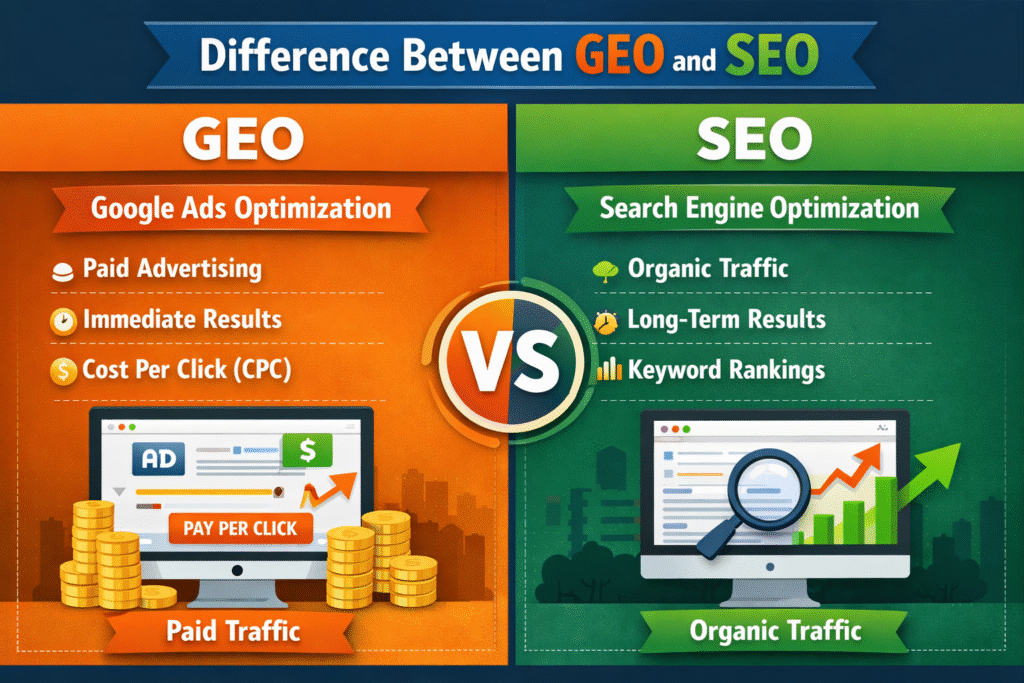
What Is the Difference Between Generative Engine Optimization (GEO) and Search Engine Optimization (SEO)?
As digital marketing continues to evolve, new technologies are changing how users search for information online. Traditional Search Engine Optimization (SEO) has been the foundation of online visibility for decades. However, with the rise of AI-powered generative engines like ChatGPT, Gemini, and other large language models, a new concept has emerged: Generative Engine Optimization (GEO).
This blog explains what SEO and GEO are, how they differ, and why businesses should understand both to stay competitive in the modern digital landscape.
1. What Is Search Engine Optimization (SEO)?
Search Engine Optimization (SEO) is the practice of optimizing websites and content to rank higher on search engine results pages (SERPs) such as Google or Bing.
Key Objectives of SEO:
Increase website visibility
Drive organic (non-paid) traffic
Improve search rankings
Enhance user experience
How SEO Works:
Search engines use algorithms to evaluate content based on relevance, quality, and authority.
Core Components of SEO:
1.On-Page SEO
Keyword optimization
Meta titles and descriptions
Header tags (H1, H2, H3)
Internal linking
2.Off-Page SEO
Backlinks
Brand mentions
Social signals
3.Technical SEO
Website speed
Mobile-friendliness
Crawlability and indexing
Secure HTTPS connections
Output of SEO:
Ranked web pages
Clickable links
Traffic directed to websites
2. What Is Generative Engine Optimization (GEO)?
Generative Engine Optimization (GEO) focuses on optimizing content so that AI-driven generative engines can understand, extract, and present it directly in their responses.Unlike SEO, GEO is not about ranking web pages—it is about being cited or referenced by AI-generated answers.
Examples of Generative Engines:
ChatGPT
Google AI Overviews
Bing Copilot
Perplexity AI
Key Objectives of GEO:
Make content AI-readable
Become a trusted data source for AI
Increase brand visibility without clicks
Appear in AI-generated summaries
How GEO Works:
Generative engines:
Analyze large datasets
Summarize information
Provide direct answers instead of links
GEO ensures your content:
Is factually accurate
Is well-structured
Answers user intent clearly
3. Key Differences Between GEO and SEO
Below are the main differences between Generative Engine Optimization and Search Engine Optimization:
1. Purpose
SEO: Ranks web pages on search engines
GEO: Gets content included in AI-generated answers
2. Platform Focus
SEO: Google, Bing, Yahoo
GEO: AI tools and generative models
3. Content Output
SEO: List of links on SERPs
GEO: Direct answers, summaries, and explanations
4. User Interaction
SEO: Requires users to click links
GEO: Provides instant responses without clicks
4. Content Structure: SEO vs GEO
SEO Content Structure:
Keyword-focused
Optimized for ranking
GEO Content Structure:
Question-and-answer based
Clear, concise, and factual
5. Keyword Usage in SEO vs GEO
SEO Keyword Strategy:
Primary keywords
Secondary keywords
Long-tail keywords
Keyword placement in:
GEO Keyword Strategy:
Natural language queries
Conversational phrasing
Semantic relevance
Context over repetition
6. Ranking Factors: SEO vs GEO
SEO Ranking Factors:
Backlinks
Domain authority
Page speed
Mobile usability
Keyword relevance
User engagement metrics
GEO Visibility Factors:
Content clarity
Factual accuracy
Structured formatting
Authoritativeness
Up-to-date information
Trustworthiness
7. Metrics and Performance Measurement
SEO Metrics:
Organic traffic
Click-through rate (CTR)
Keyword rankings
Bounce rate
Conversion rate
GEO Metrics:
Brand mentions in AI responses
Citation frequency
Content reuse by AI
Authority signals
Visibility without traffic
8. Benefits of SEO
SEO is still highly valuable because:
It drives consistent organic traffic
It supports long-term growth
It builds website authority
It improves user experience
It supports lead generation and sales
9. Benefits of GEO
GEO is becoming important because:
Users prefer instant answers
AI tools reduce search clicks
Brand visibility increases without ads
Content reaches new audiences
Future search behavior is AI-driven
10. SEO and GEO: Competition or Collaboration?
Why You Need Both:
SEO captures traditional search users
GEO captures AI-driven search behavior
Combined strategy increases digital reach
Businesses stay future-ready
Ideal Strategy:
Create high-quality SEO content
Structure it clearly for AI understanding
Use headings, bullets, and factual answers
Maintain authority and trustworthiness
11. Future of Digital Optimization
The future of search is:
Conversational
AI-powered
Answer-focused
Businesses that adapt to both SEO and GEO will:
Maintain visibility
Build authority
Stay ahead of competitors
12. Conclusion
In summary:
SEO focuses on ranking websites in traditional search engines.
GEO focuses on optimizing content for AI-generated responses.
SEO drives traffic; GEO drives visibility.
SEO is link-based; GEO is answer-based.
Both are essential in the modern digital ecosystem.
As AI continues to reshape how users find information, understanding the difference between Generative Engine Optimization (GEO) and Search Engine Optimization (SEO) is no longer optional—it is a necessity.